
What Is a Sportsbook and How Does It Work?
For anyone asking what is a sportsbook, the answer is simpler than it sounds: a business that accepts wagers on sporting events. Understanding how a sportsbook operates, how it sets prices, and what it offers bettors is the foundation for making informed betting decisions. This guide breaks it all down.
What Is a Sportsbook?
A sportsbook is an operator that takes bets on the outcomes of sporting events. The name originates from the physical ledgers, or “books,” that bookmakers used to record wagers before digital systems existed. Today, the term applies equally to physical betting shops and online betting sites, though the underlying mechanics are the same.
At its core, a sportsbook is a marketplace for betting. On one side is the bettor, who believes a particular outcome will occur and is willing to stake money on that belief. On the other side is the sportsbook, which sets prices for every possible outcome and accepts the financial risk of paying out winning bets. The sportsbook does not care who wins a match or a race. Its business model is built around pricing, volume, and margin, not prediction.
Sportsbooks cover an enormous range of events. Soccer, rugby, cricket, tennis, golf, horse racing, basketball, boxing, and motorsport are among the most popular. A major sportsbook will have hundreds of markets available on any given day, spanning domestic competitions, international fixtures, and major tournaments from around the world.
How Odds Work
The most important concept in understanding how a sportsbook functions is odds. Odds serve two purposes simultaneously: they reflect the probability of an outcome occurring, and they determine how much a winning bet pays out.
In South Africa, odds are most commonly displayed in decimal format. If a team is priced at 2.50, a R100 bet returns R250 if successful, which includes the original R100 stake plus R150 in winnings. The higher the decimal odds, the less likely the sportsbook believes that outcome is to occur, and the greater the potential payout. A heavy favourite might be priced at 1.25, meaning a R100 bet returns only R125. An unlikely outcome might be priced at 8.00, meaning a R100 bet returns R800.
Odds are not a neutral or purely mathematical expression of probability. They are commercial prices set by the sportsbook’s trading team, also called oddsmakers or compilers. These specialists analyse historical data, current form, team news, head-to-head records, injury reports, and a wide range of other variables to price each outcome. Their goal is to set prices that accurately reflect the likely outcome while protecting the operator’s margin. To learn more about how odds work read the Betline guide about what odds are and how they work.
The Overround: How Sportsbooks Make Money
If a sportsbook simply reflected true probability in its odds, it would break even over time. Instead, operators build a margin into every market. This margin is known as the overround, or sometimes the “vig” (short for vigorish).
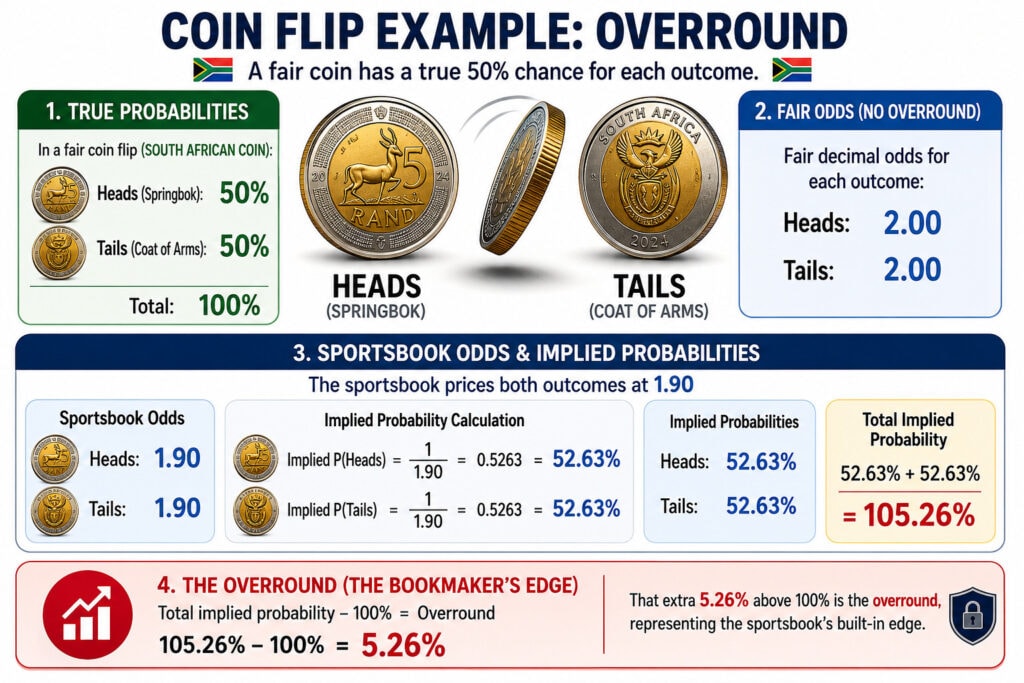
Consider a coin flip, where both outcomes have a true probability of 50 percent. Fair decimal odds for each outcome would be 2.00. A sportsbook, however, might price both outcomes at 1.90. If you calculate the implied probability of 1.90 odds, you get roughly 52.6 percent for each side. Adding both implied probabilities gives you 105.2 percent. That extra 5.2 percent above 100 is the overround, representing the sportsbook’s built-in edge.
In a real sporting event with three possible outcomes, such as a soccer match that can end in a home win, a draw, or an away win, the overround is distributed across all three prices. A bettor looking closely at any market will notice that the implied probabilities of all available outcomes always add up to more than 100 percent. That excess is what the sportsbook earns, in aggregate, over time.
Applied across thousands of bets and dozens of markets every day, the overround ensures the sportsbook profits in aggregate regardless of which individual outcomes occur. The sportsbook does not need to predict results correctly. It needs to price markets accurately enough that its margin holds across sufficient volume.
How Sportsbooks Balance Their Books
A sportsbook actively manages its exposure by trying to attract roughly balanced action across opposing outcomes. If too much money is wagered on one side of a market, the operator’s liability on that side grows significantly.
To manage this, sportsbooks adjust their odds in real time. If heavy betting comes in on one team, the odds on that team shorten, making it less attractive to new bettors, while the odds on the opposing side lengthen to draw volume the other way. This process, called line movement, happens continuously and is observable to anyone tracking prices across different operators.
Some bets, particularly large wagers or those from well-informed bettors, may be partially laid off with other operators or on wholesale betting exchanges. This process is known as hedging, and it allows sportsbooks to cap their risk on any single outcome. It is one of the reasons large bets are sometimes restricted or require manual approval before acceptance.
Types of Bets a Sportsbook Offers
The range of bet types at a modern online sportsbook is extensive. The core markets remain result-based: who wins a match, who wins a race, what the final score will be. These are the markets that drive the majority of betting volume.
Totals betting, also called over/under markets, involves wagering on whether a combined statistic exceeds or falls short of a set line. A common soccer example is whether the total goals in a match will be over or under 2.5. Handicap markets adjust the starting position of one side to create a more balanced proposition when there is a clear favourite. If a team carries a handicap of minus one goal, they need to win by at least two goals for a bet on them to succeed.
Futures markets allow bettors to wager on outcomes that will only be resolved at the end of a tournament or season, such as a league winner, a top scorer, or a championship finalist. These markets open months in advance, and odds shift progressively as the competition develops.
Combination bets, called accumulators or parlays, allow bettors to link multiple selections into a single wager. Every selection must be correct for the bet to win, which reduces the probability of success significantly, but the potential payout multiplies with each addition. A five-team accumulator at average odds of 2.00 per selection returns 32 times the stake. Accumulators are among the most popular bet types globally because they offer meaningful returns from small stakes.
Live betting, also called in-play betting, allows wagers to be placed while an event is in progress. Odds update continuously, accounting for goals, penalties, injuries, momentum shifts, and elapsed time. In-play markets have become one of the fastest-growing areas of sports betting, and most sportsbooks now offer extensive in-play coverage across the major sports.
Legal Betting Sites in South Africa












How Bets Are Settled
When a bet is placed, the sportsbook locks in both the odds and the potential payout at that moment. If the bet wins, the payout is calculated based on the odds accepted at placement, regardless of how those odds moved afterwards.
Winnings are credited to the bettor’s account after the event settles. Most standard match result bets settle within minutes of a final whistle. Player performance markets may take longer if official statistics need to be confirmed. Futures bets settle at the conclusion of the relevant competition.
If an event is abandoned or cancelled before completion, most sportsbooks void the relevant bets and return stakes to the bettor’s account. Rules around void bets, partial settlement, and late changes to event conditions are published in each operator’s terms and conditions, and it is worth understanding them before placing significant wagers.
The Role of the Trading Team
Behind every sportsbook is a trading operation responsible for setting and managing prices. Traders monitor markets continuously, react to team news and late changes, watch live events to update in-play prices, and manage the operator’s overall risk position across all open markets.
The quality of a sportsbook’s trading team directly affects the product it offers. Well-priced markets, fast in-play updates, and competitive odds on niche events are all indicators of a capable trading operation. Bettors who shop around for the best prices on any given event are effectively comparing the output of different trading teams.
🎁 Claim Your Welcome Betting Bonus Today
Explore Betline’s tailored list of the best betting bonuses in South Africa. Find a verified local site to play on and start with extra value right now.
View Bonuses & Bet Safely →Understanding the Bettor’s Position
A sportsbook offers bettors the opportunity to profit from sporting knowledge and judgement. The overround means that random betting will, on average, return less than the amount staked over time. To beat a sportsbook consistently, a bettor needs to identify outcomes that are priced less accurately than they should be, finding what bettors call “value.”
Value exists when the true probability of an outcome is higher than the implied probability in the odds. A team priced at 3.00, implying a 33 percent chance of winning, may in the bettor’s analysis have a 45 percent chance. If that assessment is correct more often than not, betting at those odds is profitable over time. This is the basis of informed sports betting, and it is what distinguishes thoughtful bettors from those who wager purely on instinct.
Sportsbook FAQs
Clear answers about sportsbooks, odds, overround, live betting, accumulators, line movement, and cancelled events.
What is a sportsbook?
How does a sportsbook make money?
What is the overround?
What types of bets can you place at a sportsbook?
What is live betting at a sportsbook?
What is an accumulator?
What is line movement?
What happens if a sporting event is cancelled?
WHAT IS A SPORTSBOOK AND HOW DOES IT WORK


South African bettors can use this guide to better understand how a sportsbook operates, including how odds are set, how the overround works, how bets are settled, and what bet types are available. Understanding these details can help bettors make more informed decisions when placing wagers at a sportsbook.