
Is Online Betting Safe? What Beginners Should Know
Online betting and reel games have grown rapidly across South Africa, becoming a popular part of the country’s regulated gaming industry. Whether it is placing a quick weekend soccer bet, following live odds during a match, or enjoying licensed reel games online, South Africans now have more entertainment options than ever before. This continued growth has helped create a vibrant online betting and gaming market that operates around the clock
Table of Contents
With smartphones, secure payment methods, and user-friendly platforms, participating has never been easier. Players can place bets from home, follow sporting events while on the move, or enjoy licensed reel games from their mobile devices. Modern betting sites also offer convenient deposit and withdrawal options, making access to regulated gaming services simple and efficient.
For anyone exploring online betting or reel games for the first time, one important question often comes up: Is it safe?
That is a valid concern. Stories about hacked accounts, payment issues, offshore operators, and unlicensed websites can make the industry appear confusing or risky. In reality, the biggest risks are typically associated with unregulated betting sites that operate outside South African gambling laws and consumer protections.
The good news is that online betting and licensed reel games can be enjoyed safely when players know what to look for. Choosing a locally licensed betting site, verifying licensing information, protecting personal details, and understanding how regulated betting sites operate can significantly reduce the risks involved. South African licensed betting sites are subject to oversight by provincial gambling boards and must comply with strict regulatory requirements designed to protect consumers.
This guide provides practical information for beginners who want to participate safely and responsibly. By the end, you will understand how to identify a legitimate licensed betting sites, verify licensing credentials, avoid unregulated offshore betting websites, and protect both your funds and personal information before placing a bet or playing a reel game online.
Legal South African Betting Sites












What Makes a Betting Site Safe in South Africa?
A legitimate South African betting site must hold an active bookmaker’s license issued by a provincial gambling board, with that license number clearly displayed, usually in the website footer and within the Terms and Conditions. Additionally, the betting site must be operated by a local company, which should also be clearly identified in the footer or Terms and Conditions.
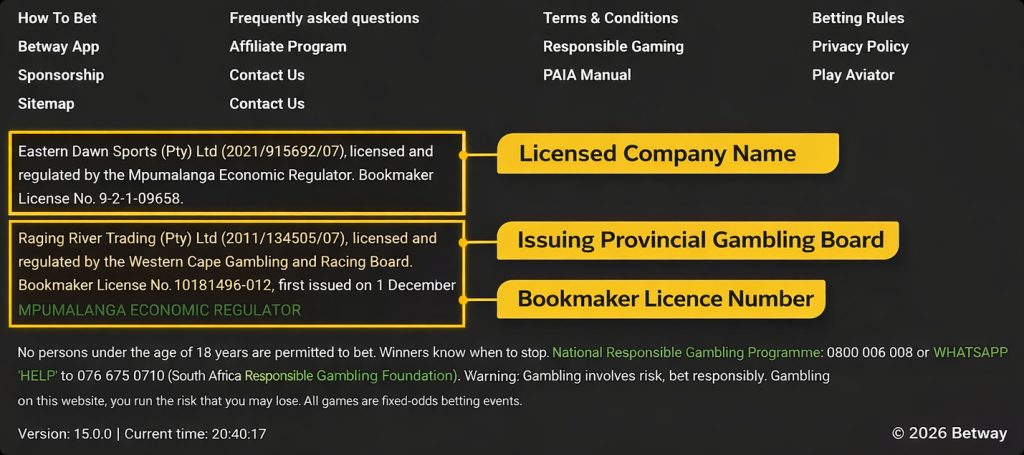
This licence is much more than a formality. It confirms that the company has met financial and integrity requirements, complies with South Africa’s FICA and POPIA laws, keeps bettors’ funds in secure, separate accounts, and is subject to regular audits and enforcement action if it fails to meet its obligations.
Licensed betting site operators are also required to provide responsible gambling tools and resources, including deposit limits, self-exclusion options, and links to the National Responsible Gambling Programme. These measures ensure bettors have built-in protection and support while they participate.
Licensed operators must comply with strict regulations for:
Core Safety Standards (South Africa)
Bettor verification (FICA)
Licensed operators must confirm your identity and address before you can withdraw. This prevents fraud, keeps minors off the platform, and helps stop account takeovers and money-laundering. Expect KYC steps such as an ID, selfie, and proof of address during signup or before first payout.
Data protection (POPIA)
Your personal information must be collected lawfully, stored securely, and used only for defined purposes. Look for a clear privacy policy, limited data sharing, and options to access or correct your data. Serious sites encrypt data at rest and in transit.
Secure local ZAR payments
Deposits and withdrawals should use trusted South African methods and process in rand (ZAR). Expect transparent fees and published payout timeframes. Avoid sites that rely on offshore processors, conceal policies, or refuse to verify your banking details.
- Recognised local payment methods (e.g., Ozow, cards, vouchers)
- Clear withdrawal rules and timelines
- Bettors’ funds kept separate from operating accounts
In addition to the above, every licensed South African betting site must use SSL encryption to secure all personal details and payment transactions, ensuring that sensitive data cannot be intercepted during logins or deposits. Betting site operators are also required to keep bettors’ funds in segregated accounts, separate from company operating money, so that your deposits and winnings remain protected and fully payable even if the business experiences financial difficulties.
Verifying these safeguards yourself is essential because the responsibility to choose a legal betting site ultimately rests with the bettor. A site may look professional and promise fast payouts, but without proof of a valid South African bookmaker’s license and compliance with local regulations, those claims carry no legal weight.
Taking a few minutes to confirm the license number, check for SSL encryption, and review the presence of responsible gambling tools helps ensure that you are dealing with a company bound by enforceable South African laws.
This simple verification protects your deposits, gives you access to dispute resolution, and helps ensure fair betting. Licensed operators are required to follow strict rules, use approved systems, and undergo independent audits to maintain transparency and bettor protection.
Payments Tell the Real Story
If a betting site hides its payment policies, delays payouts without clear reasons, or skips basic verification steps such as FICA checks, treat it as a major red flag and move on. Legitimate South African betting sites must publish clear deposit and withdrawal rules, process payments within advertised timeframes, and verify each bettor’s identity before releasing funds.
They must also transact exclusively in South African rand (ZAR) through recognised South African banks and approved local payment gateways, with no hidden currency conversions, and may accept cryptocurrency only through licensed domestic processors that meet regulatory standards.
Any operator that allows foreign currencies, adds conversion fees, uses offshore payment processors, or relies on unverified cryptocurrency channels is operating outside South Africa’s legal framework. In such cases, your funds and winnings are not protected under local gambling laws.
Safe Payments: What to Use vs. What to Avoid
Use Only Locally Regulated Options
- ZAR payments only — no forex conversions or hidden rates.
- Recognised SA banks & approved local gateways (e.g., instant EFT/card/voucher).
- Published withdrawal timeframes & clear fees (if any).
- FICA (KYC) checks before first payout; name matches bank account.
-
SSL-secured checkout — padlock and
https://visible. - Segregated bettor funds — winnings paid from protected accounts.
Avoid These Red Flags
- Foreign currencies or surprise conversion fees.
- Offshore processors that bypass SA banks or unnamed payment vendors.
- Unverified crypto channels (no local licensing/oversight).
- Hidden or shifting payout rules; no published timelines.
- No FICA verification before withdrawal.
- No SSL or browser “Not secure” warnings on payment pages.
Rule of thumb: If it isn’t ZAR via recognised South African banks or approved local gateways, don’t deposit.
Betting on foreign or unregulated betting sites is illegal in South Africa and carries serious risks, including frozen funds, blocked access, and possible legal action. Offshore betting sites offer no protection and no guaranteed recourse if something goes wrong.
It is each bettor’s responsibility to confirm that a betting site holds a valid South African license and complies with local regulations before depositing. This is the only way to ensure that your bets remain legal and your funds are properly protected.
Safety Checklist: How to Pick a Legit South African Betting Site
Before you sign up, run through these quick checks. Each item shows what to look for and how to verify it.
Valid SA Licence
Licence number visible in the footer, with the provincial gambling board named.
How to check: Match the licence number on the site with the regulator’s register (see Licensing & Legal).
Regulatory Oversight
Site states the supervising provincial board (e.g., WCGRB, GGB, MER, etc.).
How to check: Follow the regulator link or look up the operator name on the board’s website.
SSL Encryption
Padlock in the address bar; URL starts with https://.
How to check: Click the padlock to view certificate details; avoid sites with browser “Not Secure” warnings.
FICA & POPIA Compliance
KYC (ID/address) checks and a clear privacy policy.
How to check: Look for FICA/KYC steps at signup and a privacy policy covering POPIA obligations.
Local, Trusted Payments
ZAR-only with recognised SA methods (e.g., Ozow, cards, vouchers) and clear payout timeframes.
How to check: Find a payments page listing methods, fees (if any), and withdrawal timelines.
Responsible-Gambling Tools
Deposit limits, time-outs, self-exclusion, and visible 18+ notices.
How to check: Look for an RG page and in-account controls to set limits or exclude yourself.
Clear, Local Support
SA contact methods and published response times.
How to check: Find live chat, email, or phone details and test response quality before depositing.
Transparent T&Cs
Plain-language rules on bonuses, verification, and withdrawals.
How to check: Open the T&Cs and search for “withdrawal,” “verification,” and “bonus wagering.”
Complaint Path
Published dispute process and regulator escalation route.
How to check: Look for a “Complaints” page; confirm the correct provincial board is listed.
Quick rule of thumb: if any of these basics are missing or hard to verify, choose a different site.
Licence Numbers Are Your Shield
The licence number shown in the footer is not just for display. It is the quickest way to confirm that a betting site is operating under South African law and subject to regulatory oversight.
If a site does not display a valid licence number or makes it difficult to find, treat it as a warning sign and avoid depositing.
Checking this detail takes only a few seconds, but it confirms that your funds, personal information, and betting activity are protected by enforceable local regulations.
Signs of an Unregulated Betting Site
Unregulated betting sites are online operators that accept South African bettors without holding a valid South African bookmaker’s licence. Instead of being approved by a provincial gambling board, these platforms often rely on foreign registrations, commonly in places such as Curaçao or Malta, which have no legal authority in South Africa. Because they operate outside the local regulatory framework, they are not subject to South Africa’s strict rules on bettor verification, data protection, or payout procedures.
This lack of oversight creates serious risks: there is no guaranteed way to recover funds, enforce fair bets, or get help if something goes wrong. Recognising these unlicensed operators is crucial, because only a bookmaker licensed by a South African provincial gambling board can legally offer bets and provide real protection for your money and personal information.
These platforms may look polished and even offer attractive promotions, but small details usually reveal their true status. A missing or unverifiable South African licence number, reliance on foreign regulators such as Curaçao or Malta, payment options that bypass local banking channels, or withdrawal policies that ignore provincial gambling board standards all point to a site that is not locally licensed.
Offshore betting sites operate illegally in South Africa. Some have already been IP-blocked by local authorities, and further restrictions may be introduced at any time. Because these operators are not licensed by a South African provincial gambling board, bettors are not protected under local law and have no legal recourse if funds are withheld, disputes arise, or personal data is misused.

This is the actual footer of 1XBET, shown only as an educational example of an
unregulated offshore betting site that is not licensed in South Africa.
Disclaimer
The screenshot above shows the footer of 1XBET. It is presented for educational and illustrative purposes only to demonstrate features commonly found on unregulated offshore betting platforms. This inclusion does not imply endorsement, partnership, or verification by Betline.co.za.
The brand 1XBET was suggested as an option on bets.co.za, an affiliate site that states it recommends South African betting operators. Players should be cautious with any third-party recommendations and independently verify that a betting site holds a valid South African provincial gambling board licence before registering or depositing funds.
Look Out for Third-Party Recommendations
Not every website that claims to “recommend the best South African betting sites” is truly protecting bettors. Affiliate portals and review blogs often earn commissions for sign-ups, which can create a conflict of interest and lead to the promotion of offshore operators that are not licensed in South Africa.
These sites may look professional and may even promote bonuses or high “expert ratings,” but marketing content is not proof of legal compliance. Some affiliate websites include brands that hold only foreign licences, such as those issued in Curaçao or Malta, which have no legal authority in South Africa.
Even if a site promises that it “only lists trusted operators,” those claims carry no legal weight unless the bookmaker displays a valid South African provincial gambling board licence number in its footer or terms. Remember: affiliates are paid for referrals, not for verifying that a betting site meets South Africa’s strict requirements for FICA checks, POPIA data protection, and responsible-gambling tools.
Treat every third-party recommendation as advertising, not verification. Before you register or deposit, personally confirm that the betting site shows a valid South African provincial licence number and complies with local regulations. Your own licence check is the only guarantee that your money, personal data, and legal rights remain fully protected.
What Can Happen if You Bet on Offshore Betting Sites
Using an unregulated offshore betting site exposes you to serious financial and personal risks. These sites can delay or refuse payouts without consequence, change bonus terms without notice, or even close your account and keep your funds. In some cases, access to offshore betting sites may be restricted or blocked in South Africa for operating outside local regulations, which could limit your access to the betting site and potentially result in loss of funds.
Your personal details, including ID numbers, banking information, and contact data, may be stored on unsecured servers or sold to third parties, which increases the risk of identity theft or fraud.
Even if you manage to win, South African banking restrictions can block or reverse transfers from unlicensed betting sites, making it impossible to withdraw or claim your winnings. And if a dispute arises, you cannot appeal to a South African gambling board or any local authority, leaving you with no legal path to recover lost money or protect your data.
Unregulated betting sites may appear convincing, but a polished design or positive review is never a substitute for a valid South African licence. Offshore operators can close suddenly, change their terms without notice, or block withdrawals without facing any legal consequences.
Affiliate websites that promote these brands are usually marketing for commission, not verifying compliance, so their recommendations do not guarantee safety. Betline South Africa, Only features locally licensed and regulated betting sites to help bettors make informed and responsible choices.
To stay safe, always do your own due diligence. Scroll to the footer, confirm a South African provincial gambling board license number, and ensure the site accepts only rand (ZAR) through recognised local banks or payment gateways. If any of these signals are missing or unverifiable, walk away.
Verifying a licence before you deposit is the single most effective step you can take to keep your bets legal, your personal data secure, and your winnings protected under South African law.
🎁 Claim Your Welcome Betting Bonus Today
Explore a tailored list of the best betting bonuses in South Africa. Find a verified local site to bet on and start with extra value right now.
View Bonuses & Bet Safely →Avoid Scams
Even when a betting site is properly licensed, online scams remain a serious threat to your money and personal data. Criminals use clever tricks to impersonate real betting sites, steal login details, or lure bettors into fake platforms.
A safe South African betting site will never ask for passwords over email or phone, will always publish clear contact details, and will secure every transaction with modern encryption. Before you create an account or make a deposit, take a few minutes to learn how scammers work and how to protect yourself.
Building this awareness is your strongest defence. Fraudsters constantly change their methods, but most schemes share common warning signs. Understanding these patterns makes it easier to spot trouble and walk away before any harm is done. Here are some of the most frequent scams and practical ways to avoid them:
Avoid Scams — What to Watch For
Quickly scan these common tactics and how to stay safe before you click, call, or deposit.
Impersonation Emails
Emails that mimic real bookmakers and demand “urgent verification” or promise payouts. Red flags: spelling errors, “Dear Customer,” or links to unfamiliar domains.
- Do not click links in suspicious emails.
- Open a new tab and type the official site address yourself.
Look-Alike Websites
Fake sites copy a real brand to capture logins. Watch the URL for extra letters, odd extensions, or misspellings; verify the padlock and https://.
- Check the exact domain before entering details.
- Bookmark the verified URL and use it every time.
Fake Support Calls
Callers posing as “verification agents” asking for banking details or passwords. Legit operators will not request sensitive data over the phone.
- Hang up and call the number listed on the bookmaker’s site.
- Never share passwords or one-time codes.
Bogus Apps & Mirror Sites
Unofficial apps or “mirror” domains promising faster payouts or special bonuses. Clues: clumsy layout, broken links, missing licence info.
- Install apps only via official store links from the bookmaker.
- Confirm the licence with the relevant provincial gambling board.
Fake Prize Notifications
“You’ve won!” emails/SMS/DMs that demand personal info or a “release fee.” Legit sites don’t charge to pay winnings or ask for banking details over DM.
- Ignore pay-to-claim requests; report and delete.
- Verify promos inside your account, not via links.
Tip: When in doubt, stop and verify via the bookmaker’s official site or your provincial gambling board.
Scammers rely on speed and distraction, but you have the power to stop them. Slow down, double-check every message, and contact support only through the bookmaker’s verified channels or your provincial gambling board if anything feels off. Hover over links to inspect the real URL, check the sender domain, and never share passwords, one-time codes, or banking details over email, SMS, or phone. Enable 2-factor authentication (if available), use strong unique passwords, and keep your browser and apps updated.
Most importantly, bet only with locally licensed South African sites that use SSL encryption, accept ZAR through recognised banks, and publish clear withdrawal rules. Treat unexpected emails, calls, or bonus offers with caution, and report any suspicious activity. Taking these steps helps you protect your money, your personal information, and your peace of mind.
What if Something Goes Wrong?
Even when you use fully licensed South African betting sites, issues can occasionally occur. A withdrawal may take longer than expected, an account might be paused for verification, or you could have a dispute about a result or bonus condition. Understanding the correct steps and knowing which official bodies can assist gives you the best chance of protecting your funds and resolving matters efficiently.
Steps to Take if Something Goes Wrong on a Betting Site
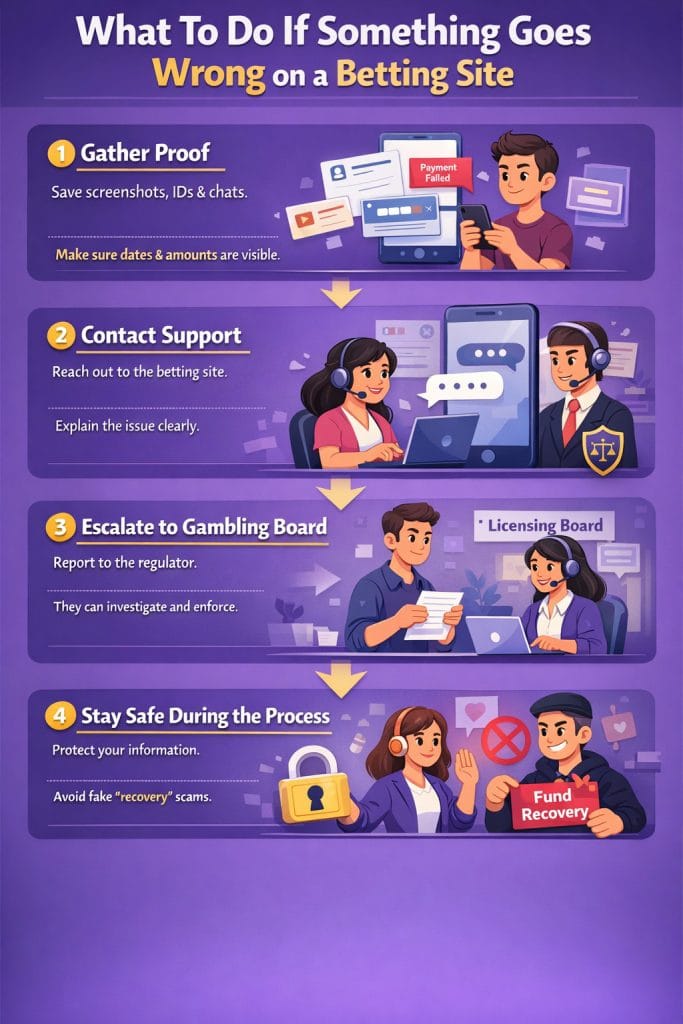
- Gather proof of the issue
Save screenshots of error messages, transaction IDs, email confirmations, or chat records. Make sure they clearly show dates, amounts, and any reference numbers. - Contact the bookmaker’s support team
Use official channels such as live chat, email, or the published phone number. Provide a clear and detailed explanation of what happened, including all relevant evidence. - Escalate to the provincial gambling board
If the issue is not resolved, report it to the gambling board that licensed the bookmaker. Legal betting sites in South Africa are required to cooperate with these regulators, who can investigate, request records, enforce payouts, and mediate disputes at no cost to bettors. - Protect your personal and financial information
While the case is being reviewed, never share passwords or banking details. Only communicate through verified bookmaker or regulator channels. - Avoid recovery scams
Ignore third-party “fund recovery” services that charge a fee. These are often scams designed to take more money or steal your information.
By acting quickly, keeping records, and using only verified channels, you give yourself the best protection if something goes wrong. Licensed South African operators are required by law to cooperate with provincial regulators, which ensures that you have a formal process to recover your money or resolve a dispute. These rights do not exist when using unregulated offshore sites.
Is Online Betting Safe on Mobile?
Mobile betting is now the first choice for many South Africans because it is fast, convenient, and allows bets to be placed from almost anywhere. Whether you use a bookmaker’s official app or a mobile browser, the same safety principles that apply to desktop betting remain important. However, mobile devices also come with their own risks that require extra attention.
Start with the basics: only download betting apps from official app stores or directly from the bookmaker’s verified website. Avoid “modded” or third-party downloads, which can contain hidden malware. Keep both your betting apps and your phone’s operating system updated to ensure you receive the latest security patches.
Enable a strong screen lock or biometric authentication and avoid saving credit card details on the device unless absolutely necessary. When logging in or making deposits, steer clear of public Wi-Fi networks, which can be intercepted by hackers. Instead, use mobile data or a trusted private network.
Finally, treat mobile phishing attempts with the same caution as email scams. Be wary of SMS messages or push notifications claiming you’ve won a prize or need to “verify” your account. Always open a new browser tab and type the bookmaker’s official address yourself if you need to log in.
With the right habits, betting on your phone can be every bit as secure as betting on a desktop. By downloading only official apps, keeping your operating system and betting software updated, and protecting your device with strong passwords or biometrics, you preserve the same legal and technical safeguards that apply to licensed South African betting sites.
Combine these steps with careful use of trusted payment methods and private networks, and you can enjoy the full convenience of mobile betting while keeping your money, personal data, and legal rights firmly protected.
Key Takeaway: Is Online Betting Safe?
Online betting in South Africa can be legal, secure, and enjoyable, but only when you follow the rules and stay alert. Safety is not a matter of luck or special tricks; it comes from the choices you make before you click “Deposit.” From checking a site’s provincial license to using only South African payment methods, protecting your login details, and recognising scam tactics, every precaution is within your control. The result of a bet may be uncertain, but the security of your money and personal information depends on the care you take before you bet.
Safe Betting Essentials — South Africa
Use this checklist before you register, deposit, or place a wager.
-
Start with licensing.
The most important trust signal is a valid South African provincial gambling board licence. The licence number—usually in the footer and Terms—proves the operator has been vetted, complies with FICA and POPIA, uses secure local payments, and keeps player funds protected. Without it, you have no guaranteed legal recourse.
-
Follow the money.
Safe sites process deposits and withdrawals only in ZAR via recognised South African banks or approved local gateways, publish clear payout timeframes, and require FICA before releasing funds. Foreign currencies, offshore processors, or unverified crypto channels put you outside SA protections.
-
Stay alert to scams.
Phishing emails, look-alike sites, fake support calls, and bogus apps aim to steal logins or funds. Slow down, check sender domains and URLs, and contact operators only through verified channels. Legit bookmakers will never request passwords or banking details by email, SMS, or phone.
-
Don’t trust third-party lists.
Affiliate rankings are advertising, not verification. Do your own checks: confirm the licence number, review policies, and ensure responsible-gambling tools are available before you register.
-
Protect your devices.
Use official apps or the bookmaker’s verified site, keep software updated, enable strong screen locks/biometrics, and avoid public Wi-Fi for logins or deposits.
-
Know your rights—and responsibilities.
Keep records and contact official support. If unresolved, escalate to the relevant provincial gambling board—they can investigate and enforce payouts, but only if you’re using a licensed operator.
The difference between a protected experience and a costly mistake lies in the actions you take before you place a single bet. Confirm that every betting site you use displays a valid South African provincial gambling board licence, use only recognised local payment channels in rand (ZAR), secure your accounts with strong passwords or biometrics, and ignore any email, call, or promotion that feels rushed or too good to be true. Set personal limits, start small, and treat every bonus or new site with healthy caution.
By making these checks a regular habit, you turn online betting from a potential risk into a safe and responsible form of entertainment supported by South African law. Your money, your data, and your overall experience remain fully within your control.
Is Online Betting Safe? FAQ
Is online betting legal in South Africa?
Yes. Online betting is legal only on operators that hold a valid South African provincial gambling board licence. Licensed bookmakers must comply with FICA identity checks, POPIA data-protection rules, and responsible-gambling standards. Offshore sites licensed only in places such as Curaçao or Malta are illegal for South African players.
How do I verify a betting site’s licence?
Scroll to the site’s footer or Terms & Conditions and look for a South African provincial licence number. Cross-check that number on the relevant regulator’s website (e.g. Western Cape Gambling & Racing Board, Gauteng Gambling Board). If the number is missing or unverifiable, avoid the site.
What payment methods are safest?
Use only South African rand (ZAR) through recognised local banks or approved payment gateways such as Ozow, instant EFT, bank cards, or regulated vouchers. Licensed bookmakers publish withdrawal timeframes and require FICA verification before releasing funds. Avoid foreign currencies, hidden conversions, or unverified crypto channels.
Can I trust third-party recommendation sites?
Treat affiliate portals and review blogs as advertising, not verification. Many earn commissions for sign-ups and may list offshore brands. Always perform your own checks: confirm the licence number, review payment methods, and look for responsible-gambling tools before registering.
How can I stay safe from scams?
Watch for phishing emails, fake login pages, bogus support calls, and unofficial apps. Always type the bookmaker’s official URL yourself, check for the HTTPS padlock, and never share passwords or banking details by email, SMS, or phone. Enable two-factor authentication and keep your devices updated.
Is mobile betting safe?
Yes—if you follow the same precautions as desktop betting. Download apps only from official stores or the bookmaker’s verified site, keep your phone’s operating system updated, use a strong screen lock or biometrics, and avoid public Wi-Fi when logging in or depositing.
What should I do if something goes wrong?
Save evidence such as screenshots, transaction IDs, and chat logs. Contact the bookmaker’s official support channels first. If the issue remains unresolved, escalate to the relevant provincial gambling board, which can enforce payouts and mediate disputes at no cost to players.
What’s the single most important safety step?
Verify the licence number before depositing. That one check ensures the site is bound by South African law, protects your money in segregated accounts, and gives you access to regulators if a dispute arises.
Browse Upcoming Sports Fixtures
Jump straight to local and international fixtures. Pick a page below to browse upcoming matches with kickoff times.
18+ Responsible Gambling
Bet safely. Know your limits.
Betting and Lotto are for adults only. Bet for fun, set limits, and only use money you can afford to lose. Winners know when to stop.
If gambling stops being enjoyable or you’re worried about your play, take a break and get support.
IS ONLINE BETTING SAFE

Betline.co.za is an independent South African betting information website focused on licensed betting sites, consumer education, and responsible gambling. Every betting site listed is checked against official licensing records to help South Africans make informed decisions before betting online.