How to Use Responsible Gambling Controls on Betting Sites
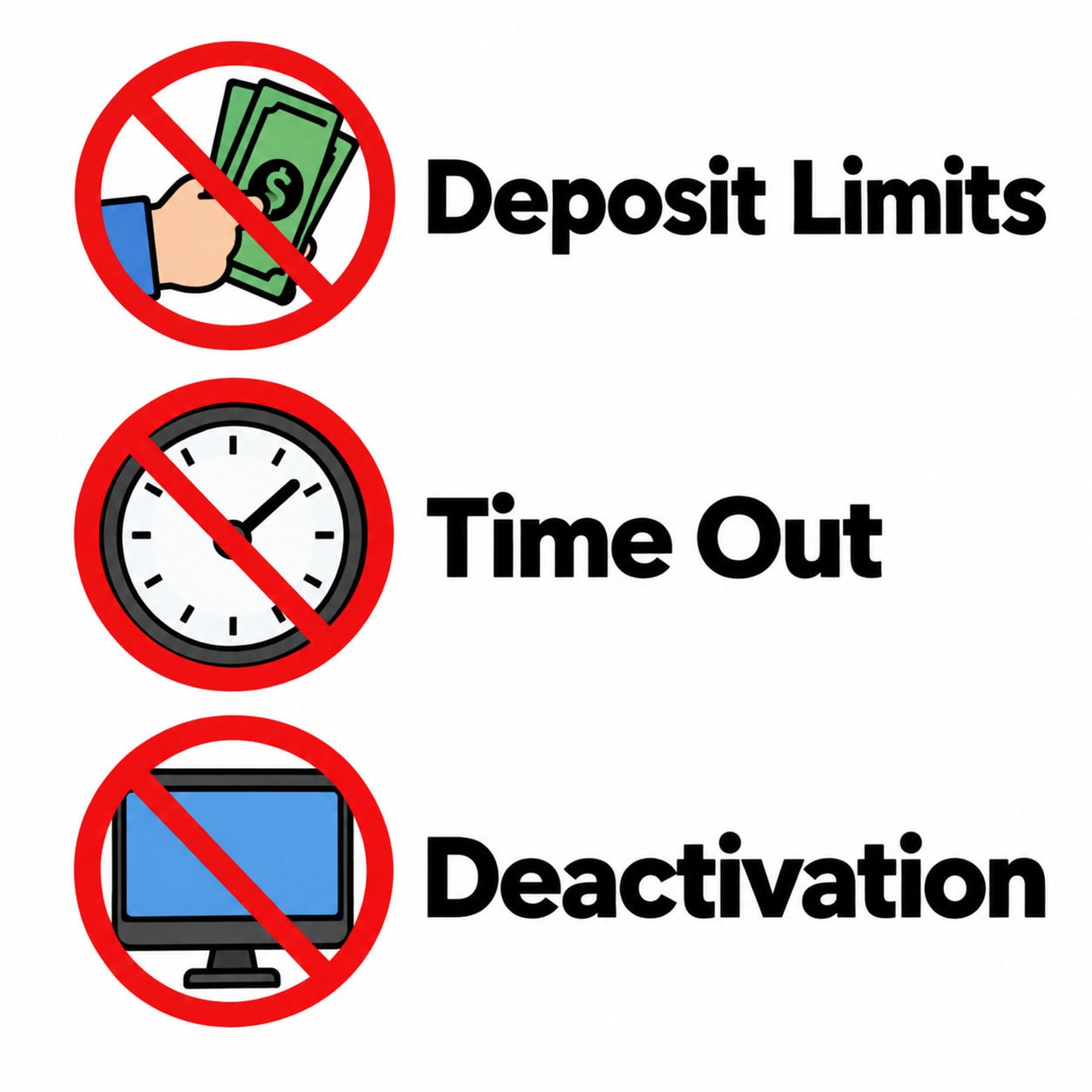
Responsible gambling starts with setting boundaries around the time and money you spend, and recognising when you need to stop. But those boundaries can become harder to follow once you are caught up in a betting session. A few minutes can turn into an hour, and a planned amount can become another deposit. Responsible gambling controls can help you put limits in place before that happens, giving you a practical way to support the decisions you make before you start.
Depending on the betting site, these responsible gambling controls allow you to limit deposits, take a time-out, or temporarily deactivate your account. They serve different purposes, so it helps to understand what each one does and what to know before using them. A deposit limit controls how much money you can add to your account, while a time-out restricts account use for a chosen time period. This guide explains where to find these tools, what to check when using them, and how to recognise when a longer break or additional support might be needed, with clear instructions and example images.
Where to find responsible gambling controls
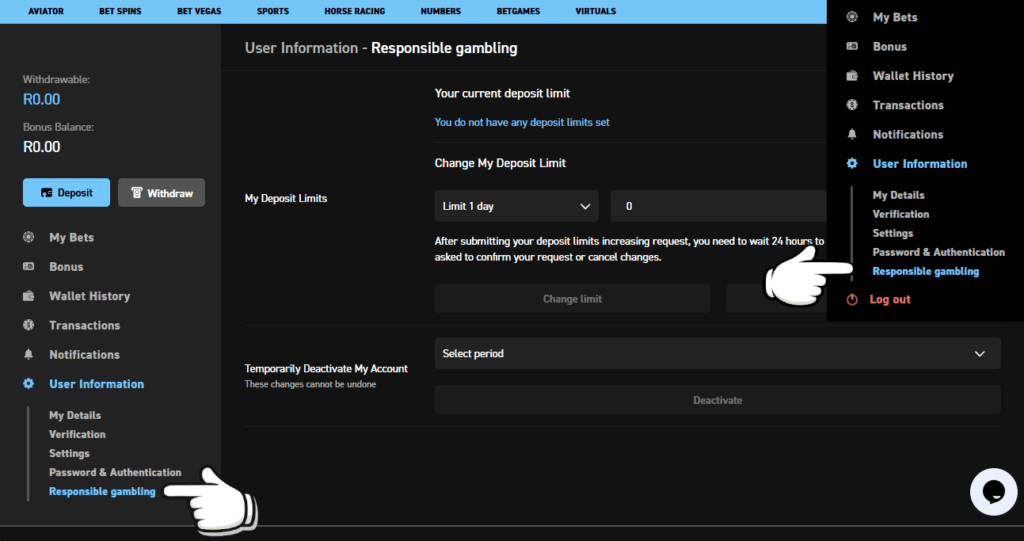
Start by signing in to your betting account and opening your profile, account settings, or account management dashboard. Look for Responsible gambling under User Information, or Time-Out under My Profile. The wording and location will differ between websites. If you cannot find the controls, contact customer support and ask how to access deposit limits, temporary account restrictions, and self-exclusion.
Before activating a control, read its conditions carefully. Check what it restricts, when it takes effect, how long it lasts, and if it applies to all gambling products on that account. After entering your settings, select the relevant Submit, Change limit, or Save Changes button and look for confirmation that the restriction is active. Do not assume that selecting an option has completed the process if the site still requires a confirmation step.
Use deposit limits to set a spending boundary
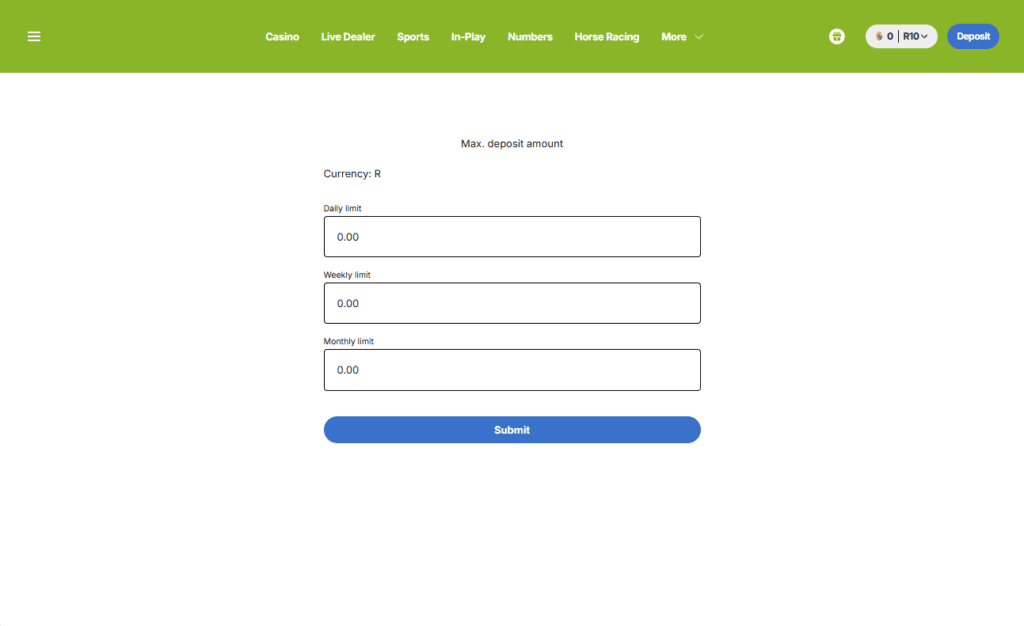
A deposit limit controls how much money you can add to your betting account within a particular period. Depending on the settings offered by each operator, you may be able to enter separate daily, weekly, and monthly limits, or select a period and enter an amount. Setting these limits in advance can help you avoid making repeated deposits during a session, particularly when you feel tempted to recover money you have already lost.
Choose your limits after accounting for essential expenses, savings commitments, and other responsibilities. The amount should be money you can afford to lose entirely, without needing to replace it through another bet. For example, if you set a monthly deposit limit of R200, that is a ceiling on what you can add during the relevant period, not a target you need to spend. Think about how your daily and weekly amounts fit within that monthly boundary, and check when each period resets.
It is also important to distinguish deposits from wagers and losses. You may be able to wager existing funds or winnings repeatedly without making another deposit, so the total value of your bets can exceed your deposit limit. Check the rules for changing limits too: requests to increase them could involve a 24-hour waiting period before you can confirm or cancel the change. If a field displays 0.00, check how the betting site interprets that value rather than assuming it means deposits are blocked.
Make stopping a deliberate decision
Keeping track of time can be difficult when you are focused on results or waiting for the next event. Decide on your stopping time before you begin, and plan what you will do when you reach it. That could mean signing out and moving on to another activity, rather than extending the session because you are winning or trying to recover a loss. An alarm can help you notice the time, although it will not prevent you from continuing.
If you repeatedly extend your own deadline or return soon after deciding to stop, consider using a time-out or temporary account deactivation. These controls create a defined period away from the account. Choose the length of your break according to what you need, and use that time to consider whether gambling is taking more of your attention or money than you intended.
Take a temporary break with a time-out
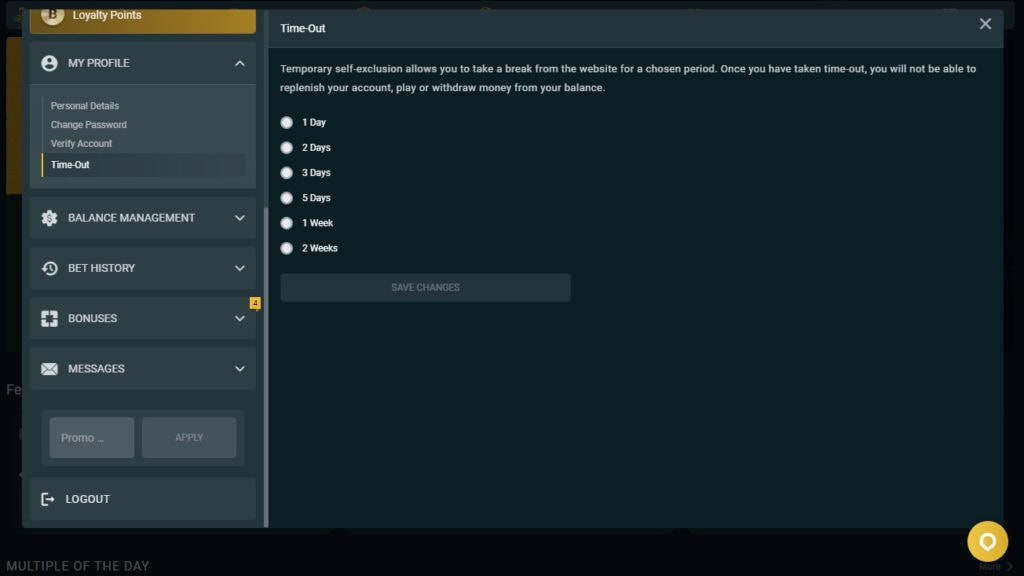
A time-out provides a temporary break from the website for a chosen period. Under My Profile → Time-Out, select an available duration and save your changes. Options can include 1 day, 2 days, 3 days, 5 days, 1 week, or 2 weeks. Before activating the break, check when it begins, whether it can be reversed, and what happens when the selected period ends.
Read the restrictions carefully, because a time-out can affect more than your ability to place bets. Its conditions may prevent you from adding money, playing, and withdrawing money from your balance during the break. If you have funds in the account or a withdrawal already pending, make sure you understand how these will be handled. Contact support if the terms do not make this clear.
Use the break to look at how gambling has been affecting your spending, mood, and daily routine. Reviewing your transaction history can help you compare what you intended to spend with what you deposited and withdrew. If you have accounts with other betting sites, consider those as well: a restriction on one account does not cover another. Moving to a different betting site during the break would undermine the boundary you were trying to establish.
Understand temporary deactivation and self-exclusion
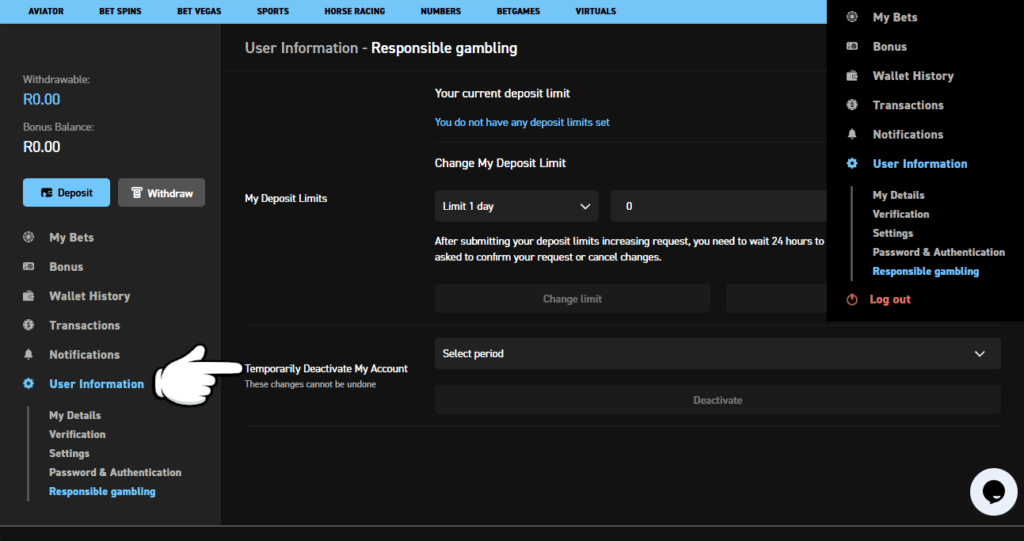
Temporary account deactivation is another way to restrict access for a selected period. In the Responsible gambling section, look for Temporarily Deactivate My Account, select a period, and choose Deactivate. Check the available durations and read the warning before confirming. Where the page states that changes cannot be undone, do not assume that you can return early simply by changing your mind.
Although temporary deactivation and time-outs both provide a break, their conditions may differ. Just like with time-outs, check how deactivation affects your balance, withdrawals, and access to the account, as well as what happens when the deactivation period ends. If you are struggling to stay within limits or finding that temporary breaks are not enough, ask the betting site operator about formal self-exclusion and whether a broader restriction is available.
In South Africa, the South African Responsible Gambling Foundation explains that formal exclusion can be requested through gambling operators or provincial gambling boards, with counselling and support available through the National Responsible Gambling Programme. Read the Foundation’s self-exclusion guidance and confirm the requirements for your application. Do not assume that temporarily deactivating an account is the same as registering for formal self-exclusion, or that excluding yourself from one site automatically blocks every gambling service.
Recognise when limits are no longer enough
Responsible gambling controls can help you act on boundaries, but they do not make gambling risk-free or guarantee that it will remain manageable. Know the signs of problem gambling and pay attention if you start treating a limit as something to get around—for example, opening another account after reaching a deposit cap, borrowing money to continue, or repeatedly increasing the amount you intended to spend. If you are doing these things to win back money you have lost, you may be chasing losses. That is a reason to stop and reassess, rather than move the boundaries you originally set.
You do not need to wait until gambling has caused a crisis before seeking help. If it is affecting your finances, relationships, sleep, or ability to focus on everyday responsibilities, support is available. In South Africa, contact the South African Responsible Gambling Foundation on 0800 006 008, or send HELP via WhatsApp or SMS to 076 675 0710. You can also visit Responsible Gambling South Africa to find assistance for yourself or someone close to you.
Frequently Asked Questions
Common questions about deposit limits, time-outs and temporary account deactivation on betting sites.
-
Where can I find responsible gambling controls on my betting account?
Sign in and open your profile or account settings. Look for Responsible gambling under User Information, or Time-Out under My Profile. Menu names differ between betting sites, so contact customer support if you cannot find the controls.
-
How do I set a deposit limit?
Open the deposit limits section, select a period or use the separate daily, weekly and monthly fields, and enter your chosen amount in rand. Select Change limit or Submit, complete any confirmation steps, and check that your new limit is active.
-
Does a deposit limit also limit how much I can lose?
A deposit limit restricts the amount you can add to your account during a set period. It does not necessarily cap losses or the total value of your bets, because existing funds and winnings may still be wagered. Set your limit using money you can afford to lose after covering essential expenses.
-
Can I increase my deposit limit immediately?
An increase may require a waiting period. Some controls require you to wait 24 hours before confirming or cancelling an increase request. Check the conditions and the status of your request rather than assuming the higher limit applies immediately.
-
How do I activate a time-out?
Open the Time-Out section, choose an available duration, and select Save Changes. Options may include 1 day, 2 days, 3 days, 5 days, 1 week or 2 weeks. Read the restrictions and complete any confirmation steps before checking that the break is active.
-
Can I withdraw money during a time-out?
Check the time-out conditions before activating it. Some time-out controls prevent deposits, play and withdrawals for the selected period. If you have money in your account or a pending withdrawal, ask support how it will be handled.
-
How do I temporarily deactivate my betting account?
Open Responsible gambling, find Temporarily Deactivate My Account, select an available period, and choose Deactivate. Read the warning carefully: where the site states that the changes cannot be undone, do not assume you can reverse the restriction before the period ends.
-
Is temporary account deactivation the same as formal self-exclusion?
Do not assume they are the same. Temporary deactivation restricts an account under the terms of the operator, while formal self-exclusion has its own application process and conditions. If you need a longer or broader restriction, ask the operator about self-exclusion and exactly which accounts or venues it covers.
-
Will a time-out on one betting site block my other accounts?
Do not assume that a time-out or deactivation on one site restricts accounts with other operators. Check the scope of the restriction. If you need a break from gambling, using another account during that period undermines the boundary you have set.
HOW TO USE RESPONSIBLE GAMBLING CONTROLS